
Welcome to the new era of software development – one often dubbed “vibe programming” – where coding isn’t about keystrokes anymore but about orchestrating a symphony of AI agents. This paradigm shift is rewriting the rules of programming overnight. In the words of one early observer, it’s “the new frontier where non-coders build software, experienced developers become superhuman, and the rules of programming are being rewritten overnight”. Coined by AI pioneer Andrej Karpathy in 2025, vibe coding originally described a style of building software by “fully giving in to the vibes” – letting an AI assistant generate code while the human guides via natural language. Now, this revolution has evolved further into agentic coding, where developers don’t write code line-by-line at all. Instead, they define high-level objectives and oversee AI agents that plan, code, test, and deploy features autonomously. In short: it’s not about how to code, but what to code.
In short: it’s not about how to code, but what to code.
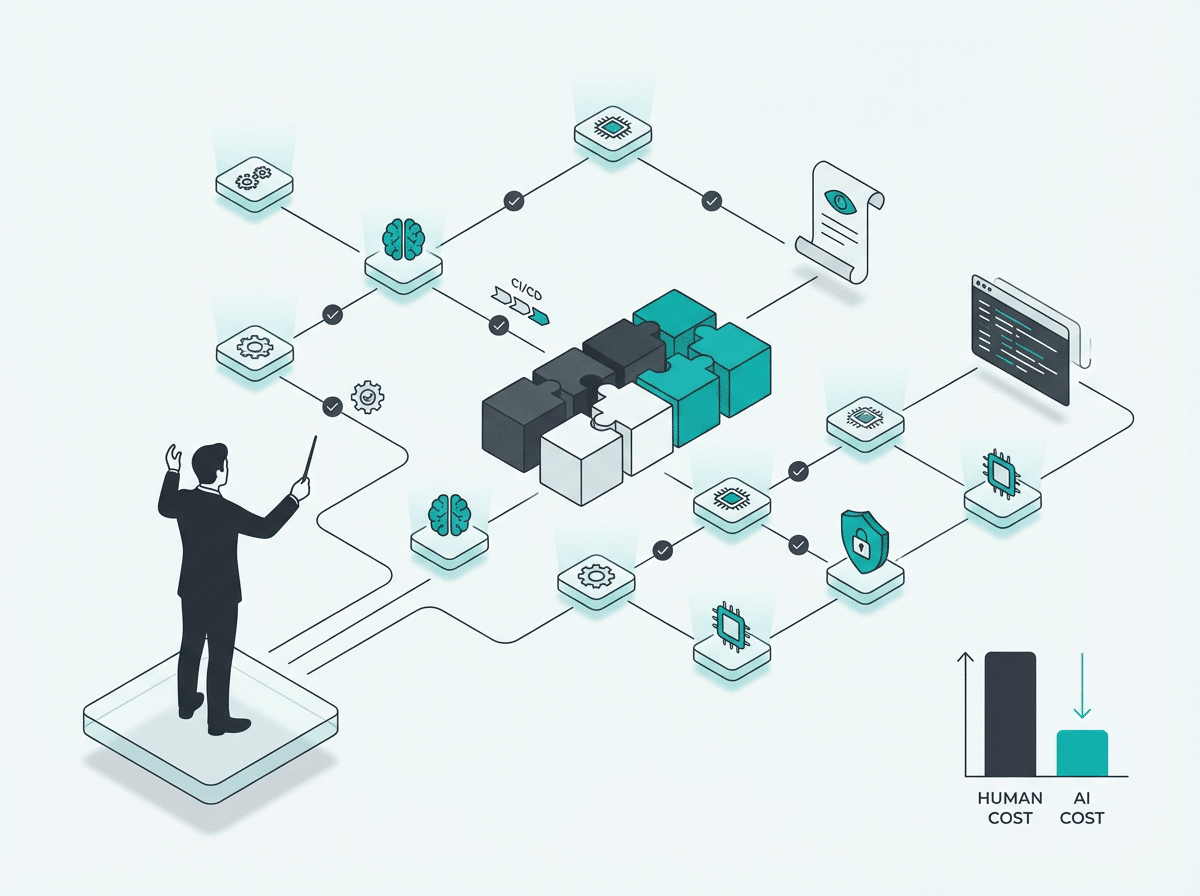
From Coding to Orchestrating: A Paradigm Shift
Traditional programming was like handcrafted carpentry – carefully writing every function and loop. Vibe programming, by contrast, feels like leading a team of intelligent apprentices. The human engineer provides vision and direction, and the AI agents do the heavy lifting. Your role shifts from coder to conductor. As one definition explains, “You don’t give detailed prompts. You give objectives like ‘Refactor the API layer for scalability and update all related documentation.’ The AI agent then plans, executes, tests, and reports the results.” Instead of micromanaging syntax, you manage intent, quality, and flow.
At RocketEdge, we’ve fully embraced this shift. We use GitHub Copilot’s new coding agent mode integrated in VS Code and Visual Studio Enterprise to turbocharge our development process. Rather than spending days or weeks grinding through routine backlog tasks, we hand them off to AI agents and oversee the outcomes. The result? Features and fixes that used to take weeks now get completed in hours or days, with our engineers focusing on high-level design and validation. GitHub’s own engineers have found that many “lingering backlog issues no longer stand a chance” when equipped with Copilot agents tackling them in parallel. We’ve seen the same – whether it’s updating a dependency across the codebase, adding a batch of unit tests, or migrating a legacy module, an AI agent can handle the grunt work tirelessly and consistently. The team’s time is freed to concentrate on creative architecture and critical problem-solving instead of boilerplate.
Critically, Generative AI is an amplifier of talent, not a replacement. It lowers the floor and raises the ceiling. Junior developers and non-coders can achieve respectable results with AI assistance, but experts can leverage it to achieve superhuman productivity. Internal studies and anecdotes abound: one recent summit noted that AI adoption can yield a 10× boost in output, but only after an engineer puts in the effort to truly master the toolset. In practice, that means there is a learning curve – roughly “2,000 hours, or a full year, to develop ‘trust’ in the AI” such that you can predict its behavior and harness it effectively. This trust isn’t about blind faith; it’s about understanding the AI’s strengths, quirks, and failure modes (hallucinations, errors) through experience.
As an engineer, if I am not spending the equivalent of my salary on tokens, I am doing something wrong.
That tongue-in-cheek quip reflects a serious point: to get 10× results, you may need to scale up your usage of AI (and the compute behind it) dramatically. The ROI is there – AI assistance is astonishingly cheap relative to human labor – but only if you actually use it pervasively. And those who do use it pervasively are pulling ahead. There’s already a “revenge of the junior developer” underway: young engineers and even students, unencumbered by old habits, are fearlessly hitting AI agents with questions and experiments until the code works – and often outperforming seniors who stick to manual methods. The message is clear: adapt or fall behind. Veteran programmers who refuse to embrace AI risk seeing their productivity regressed to intern-level within a year. Meanwhile, forward-thinking teams treat AI as a force multiplier for their best people rather than a crutch for the inexperienced. In our experience, the sweet spot is pairing senior engineering insight with aggressive AI leverage – a combination that yields phenomenal results.
The Economics of Agentic Code: Cost and Productivity
Why is RocketEdge betting big on AI-driven development? One look at the economics says it all. AI coding agents can write code orders of magnitude faster and cheaper than humans, fundamentally altering the cost structure of software engineering.
Consider a simple metric: the cost to produce 100 lines of code (LoC). A seasoned Western developer might earn a six-figure salary, which works out to roughly $2–$3 per line of code when you factor in productive coding time. An offshore contractor in a lower-cost market (say, India or Vietnam) might bring that down to around $0.50 per line. Now compare: modern large language models (LLMs) can generate that same line of code for fractions of a cent – on the order of $0.001 or less. In other words, AI is 1000× to 10,000× more cost-effective at churning out code. Even when you account for code review and iterations, the difference is staggering. Figure 1 below provides a visual comparison:
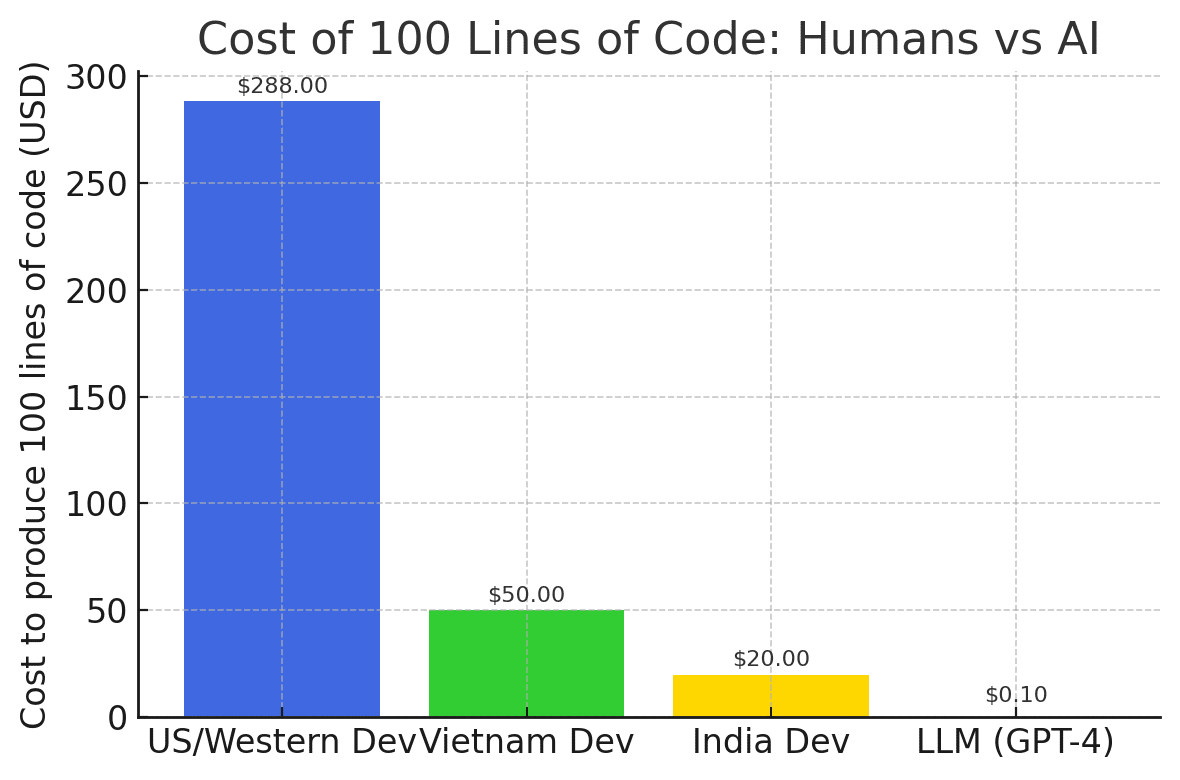
Figure 1: Approximate cost to produce 100 lines of code by different sources. A US-based professional developer might cost about $300 for 100 LoC, while an offshore developer in Vietnam or India can do it for a few dozen dollars. Modern AI models (e.g. GPT-4) can generate 100 lines for pennies. The economic incentive to offload routine coding to AI is enormous.
This isn’t just about cost – it’s also about speed and throughput. A human coder might type (and think) through code at, say, ~2 tokens (words or code symbols) per second. State-of-the-art AI models can output 50+ tokens per second, never tire, and can run 24/7. They can also be scaled horizontally: need 10 features developed overnight? Spin up 10 AI agent instances in the cloud and get it done (just be ready to handle the integration – more on the “merge wall” later). In one anecdote, a lead AI engineer set loose a swarm of 8 coding agents on a backlog of 30 issues; in a matter of hours, all 30 were implemented and closed while he was busy elsewhere. That kind of parallel throughput simply wasn’t imaginable before. GenAI doesn’t replace human developers; it replaces idle time – those waiting weeks in a queue for IT to finish a migration, or grinding through repetitive boilerplate. By offloading the undifferentiated heavy lifting to machines, your team can deliver more in the same time frame, accelerating time-to-market.
Of course, raw speed is nothing without control. An AI that can generate bugs 25× faster isn’t helpful. Fortunately, we’ve found that with proper use, AI increases productivity without sacrificing quality – but it requires new practices (and a mindset of always verifying the AI’s output). GitHub’s engineering blog emphasized using Copilot agents for “tireless execution” of well-scoped tasks, while keeping humans in charge of cross-system design and final review. In other words, let the AI factory-farm the code, but human engineers still define what needs to be built and ensure it fits together correctly. Which brings us to an essential aspect of vibe programming: codebase readiness and AI-compatible engineering practices.
Codebase Readiness: Write Code for Humans and Machines
Martin Fowler famously said, “Any fool can write code that a computer can understand. Good programmers write code that humans can understand.” In the age of AI, this maxim takes on a new twist. We now need to write code that both humans and AI agents can understand, verify, and improve. That means clean, organized, and well-validated code isn’t just a matter of developer ergonomics – it directly determines whether your AI assistants succeed or fail.
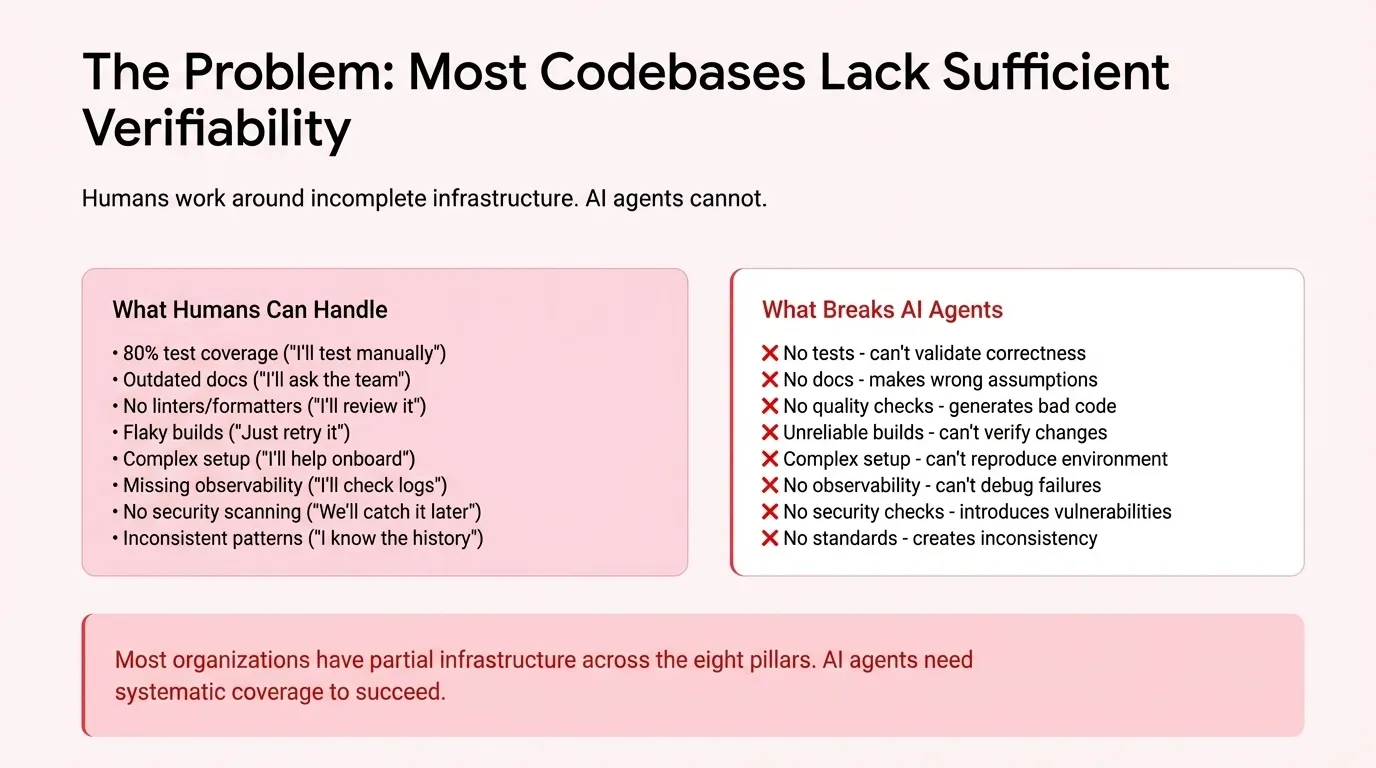
Figure 2: Human developers can work around incomplete engineering infrastructure, but AI coding agents cannot. Left side shows what humans often tolerate – e.g. only 60% test coverage (“I’ll just test this part manually”), outdated documentation (“I’ll ask a teammate if unsure”), missing linters or flaky build scripts (“I’ll retry or fix it on the fly”). Right side shows what breaks AI agents – no tests means the AI can’t verify its changes, no docs means the AI makes wrong assumptions, unreliable builds prevent the AI from validating code, missing observability means the AI can’t debug failures, and so on. Most teams have gaps like these; closing them is critical for successful autonomous coding. Source.
The takeaway is clear: robust engineering fundamentals are the prerequisite for agentic automation. If your codebase lacks proper tests, documentation, code style standards, and CI/CD checks, a human developer might cope through experience and intuition – but an AI agent will stumble. Unlike humans, the AI can’t “fill in the blanks” with common sense or tribal knowledge. Every ambiguity or inconsistency in your dev environment increases the chance the AI will produce faulty output or get stuck. As an example, if there’s no unit test, the AI has no reliable way to know if its code actually works – it might happily introduce a subtle bug and have no mechanism to catch it. If the build is broken or the instructions to run the project are out-of-date, the AI can’t magically intuit what to do – it will likely error out.
At RocketEdge, we’ve learned that investing in machine-friendly codebases pays off tenfold. We emphasize:
- High test coverage and explicit expected outputs: Not only do we aim for thorough unit and integration tests for human quality reasons, we also know these tests enable AI agents to validate their changes. For any planned autonomous refactor or migration, it’s essential to have a test suite the AI can run. In practice, we even script certain verification steps as part of the task. For instance, before an AI agent refactors an API module, we’ll capture the actual responses of each endpoint (status codes, payloads, headers) and save them. The agent uses these as a baseline to ensure its refactored version matches the original behavior. This kind of self-checking harness lets an AI confidently do large-scale changes without regressions. As one of our senior devs put it: “Good programmers write code that humans can understand – and good vibe programmers write code that AI can safely work with.”
- Clean organization and naming conventions: We enforce logical project structure and consistent naming not just for stylistic purity, but because AI agents rely on those cues. An AI reading your repository will make assumptions based on file names, directory layout, and identifier names. If your code is a tangled mess, the AI’s internal model might get confused or make incorrect inferences (“Utilities_v2_final REALLY FINAL” is not helpful for anyone, human or AI). On the other hand, clear modular separation and descriptive names act like documentation for the AI. We even write comments specifically addressed to future AI agents – e.g. explaining the intent behind complex code or noting known pitfalls – knowing that large language models will pick up those comments when modifying code later. This is a new form of documentation: writing for an AI audience. It forces a healthy clarity that benefits human maintainers too.
- Standards and static analysis: Linters, formatters, and code quality gates are mandatory. They ensure that AI-generated code doesn’t introduce stylistic chaos or obvious bugs. In fact, we often run linters as part of an AI agent’s workflow (the agent can be prompted to fix lint errors it finds). We treat the AI agent like a junior developer: we’ve set up automated quality checks it must pass before its code is accepted. This not only improves output, it also teaches the AI incrementally (via the feedback) what the project’s standards are.
- In-line documentation and examples: When assigning tasks to an AI (especially via something like GitHub Copilot’s agent interface), providing rich context is key. That’s the “W” in GitHub’s recommended WRAP framework: “Write effective issues”. We will include code snippets, configuration details, and acceptance criteria in the task description, just as we would onboard a human contributor. For example, instead of saying “Implement feature X,” we might say: “Implement feature X in module Y. Use pattern Z (see
ExampleClassfor reference). Ensure to update documentation atdocs/FEATURE_X.mdaccordingly and add tests for A, B, C scenarios.” The extra upfront effort pays off when the AI agent produces the correct solution with minimal back-and-forth. Remember, an AI agent is extremely literal – it will do exactly what you ask, so you must ask precisely for what you want.
In summary, engineering for AI is really just excellent software engineering. It means writing code that is easy to read, has unambiguous structure, thorough verification, and clear intent. We’ve found that by holding our code to a standard where “an AI could navigate it,” we also make it superbly maintainable for any human developer. As a bonus, code quality issues that previously lingered (“we should really add tests someday…”) get surfaced sooner – because if you don’t fix them, your AI helpers might choke on them. This dovetails with an insight from AI veteran Steve Yegge: spend 40% of your time on code health, or you’ll spend 60%+ later fixing problems. In vibe programming, that means regularly tasking AI agents to review and improve the codebase itself – find dead code, add missing tests, simplify overly complex sections – to prevent a gradual quality decay. The better shape your repo is in, the more trust you can place in agents to handle bigger changes.
Best Practices in Agentic Development: Orchestration and Autonomy
Beyond code cleanliness, succeeding with AI agents requires new processes and tools. It’s not just “coding” anymore – it’s operations. Here are some of the emerging best practices we champion:
- Agent Orchestration Dashboards: When you have multiple AI agents working on different issues, you need a way to manage and monitor them – akin to a mission control. The classic IDE isn’t enough. We’re moving from the era of individual coding in VS Code to an era of overseeing fleets of agents from an agent dashboard. GitHub’s recent introduction of “Agent HQ” envisions exactly this: a unified panel where you can see all AI tasks, their status, and outputs across your editor, CLI, and cloud. Steve Yegge suggests that the future of development environments will look more like orchestrator consoles than text editors. At RocketEdge, we have prototyped our own internal dashboard that shows each active agent (with a nickname), the issue it’s working on, progress (which file or test it’s on), and any queries it’s made. We can intervene in real-time if needed, or let them run asynchronously while we do other work. This kind of top-down visibility is essential to scale agentic workflows safely. It’s surprisingly analogous to managing a team of human developers – you want to know who’s doing what, and catch if someone (or some thing) is stuck on a blocker.
- Multi-Agent Coordination and the “Merge Wall”: Running one AI assistant is straightforward; running 5 or 10 in parallel on interrelated code is uncharted territory that introduces a new bottleneck: integration. When multiple agents generate code changes concurrently, you inevitably face merge conflicts and overlapping edits – what Yegge calls “smacking into the Merge Wall”. For example, if agent A refactors the logging module while agent B changes the database schema and agent C updates an API interface, there’s a good chance their work will conflict at integration time. Each agent starts with the same baseline and doesn’t (yet) dynamically account for other agents’ simultaneous changes. The solution is to introduce a controlled merge queue or serialized integration phase. In our process, we stagger agents or use a primary orchestrator that sequentially merges agent contributions one by one, rebasing the remaining work after each merge. We treat it like an automated CI pipeline: each agent’s output is merged, tests run, then the next agent’s turn – with any necessary rework if conflicts occur. It’s not fully autonomous; human judgment may be needed for thorny conflicts. This is an active area of R&D in the field – how to let agents collaborate without stepping on each other’s toes. Some tasks are embarrassingly parallel (agents working on completely separate areas), but many require awareness of global changes. Until AI can handle complex merges itself, human engineers remain the ultimate integrators. The key is designing work packages that minimize overlap (e.g. don’t have two agents concurrently edit the same file), and being ready to manually assist when the AI hits a merge wall. As Yegge observes, even if 3 agents can implement 30 features blazingly fast, merging their work is “often messy and not entirely automatable” – sometimes you must pause and coordinate. Knowing this, we plan our agent swarms carefully and employ an orchestrator agent or script to handle merges one at a time. The bottom line: agent swarming can yield spectacular productivity bursts, but you need a strategy for the reduce phase (integration) or you’ll negate those gains with merging headaches.
- Guardrails and Feedback Loops: Agentic coding introduces new failure modes – an AI could make a destructive change (drop a database table, for instance) if not properly constrained. We implement multiple guardrails. First, we run agents in restricted environments (no production access until human review, limited permissions on what they can do). Second, we utilize feedback loops: after an agent finishes a task, another agent (or a test suite) can be assigned to review its output. This “pair agent programming” approach catches mistakes. It echoes the old adage of code reviews – except now an AI can do an initial review pass automatically. In fact, GitHub’s WRAP framework’s “P = Pair with the coding agent” suggests always keeping a human-in-the-loop to review and polish the agent’s code. We absolutely agree. AI code generation is powerful, but you should never deploy code an AI wrote that nobody has read. The good news is that AI can help here too: often the human and a helper agent reviewing together can iterate to a final solution quickly. Remember: “Coding is not typing. AI helps you make progress toward goals, not replace your judgment.” In practice, that means we treat AI suggestions as proposals that must be validated, not gospel.
- Continuous Learning and 2,000-Hour Threshold: Lastly, a best practice that sounds soft but is very real: budget significant time for your team to learn and experiment with these tools. There’s a reason Yegge noted it takes on the order of 2,000 hours to develop true “trust” in using AI agents. That trust is really a proxy for skill and intuition in working alongside the AI. We encourage our engineers to spend a portion of their week just exploring what the AI can do – writing small throwaway programs, trying new prompts or agent frameworks, reading about the latest updates (which come fast in this field), and sharing tips. Internally we run short “AI hackathons” where the only goal is to automate something surprising. This culture of curiosity and relentless experimentation keeps us on the leading edge. It’s not enough to buy some Copilot licenses and call it a day – you need to foster a team mindset of always pushing the envelope with how AI can be applied. Those invested 2,000 hours pay off when an engineer suddenly finds a way to automate a month-long project using an AI agent in a weekend.
From Engineers to AI Engineers: The Human Edge
Adopting vibe programming doesn’t mean humans become irrelevant – far from it. The role of the engineer evolves into one that is even more demanding of high-level skill. In the future, the most valuable developers will be those who can master this AI-powered toolchain and leverage it creatively. Think of them as AI orchestrators. They combine deep software engineering know-how with the ability to direct AI systems to achieve business goals. This is what some call the rise of the “AI Engineer” – a professional who might write some code, but spends as much time writing prompts, curating data for models, and designing processes for AI to follow.
RocketEdge is deliberately positioning itself at the forefront of this shift. We are not interested in hiring armies of cheap, interchangeable coders to crank out lines of code. Instead, we seek developers who can maximize output through orchestration tools and their own creativity. These are developers with an ownership mentality and self-direction – the kind who, if a tool is lacking, will script their own, or if an AI agent is stumbling, will debug the why and engineer a solution. We look for the curious and the bold experimenters, because this field is so new that no single playbook exists. In interviews, we might ask about how a candidate automated a personal project with AI, or how they would design a system of multiple agents to solve a complex task. The ideal RocketEdge engineer is as comfortable writing a prompt or configuring an AI agent’s environment as writing a function in Python or C++.
This philosophy echoes what industry leaders are saying: The future of coding is knowing how to work with AI, not compete against it. One senior engineer recently compared traditional coding to subsistence farming – crafting everything by hand – and agentic coding to industrial farming with heavy machinery. The machinery (AI) doesn’t eliminate the farmer; it empowers them to produce exponentially more if they know how to drive the tractor. Our goal is to have the best “AI tractor drivers” in the industry. These are people who still deeply understand software architecture, algorithms, and quality, but they channel that expertise through AI agents. They know that “the future favors those who can orchestrate AI effectively, not those who compete with it on repetitive tasks.” In other words, typing speed or memorized coding tricks matter less; designing a system, setting the right goals, and guiding the AI – those are the critical skills.
We also emphasize a mindset of continual learning. Given how fast AI tech is evolving (what works this month might be obsolete next month), an elite engineer in this space must be adaptable. We encourage taking online courses, participating in AI dev communities, and even contributing back (responsibly) to open-source AI projects. The culture here is one of perpetual beta. That can be a big adjustment for those used to slower-moving enterprise tech, but it’s incredibly energizing. When an engineer discovers a new prompt engineering technique or a plugin that boosts agent reliability, it’s shared across the team and immediately tried out on real projects. The toolkit is expanding weekly – staying on the cutting edge is part of the job.
Conclusion: Orchestrate or Obsolete
Software engineering is entering a new epoch. The transformation is underway, but human judgment, creativity, and strategic thinking remain irreplaceable. What’s changing is how we apply those human strengths. The emphasis moves from manual implementation to strategic orchestration. Teams that leverage AI agents to their fullest will leave their slower competitors in the dust. Those that don’t will find themselves churning out code that could have been generated in a fraction of the time, for a fraction of the cost.
The message for technical leaders is clear: empower your engineers to be AI conductors. Provide them with the tools, infrastructure, and training to exploit these new capabilities. Insist on the coding standards and workflows that make your environment AI-friendly. Cultivate the culture of experimentation and learning. Do this, and your developers will become 10× more effective, tackling backlogs and bold initiatives that previously seemed impractical. Ignore the trend, and you may wake up to find that your tried-and-true development processes are hopelessly behind the state of the art.
At RocketEdge, we’re proud to be among the pioneers of the vibe programming revolution. Our engineering mantra is simple: “It’s not about how to code, but what to code.” By freeing our talent from the drudgery of boilerplate and letting them focus on creative problem-solving, we’re delivering faster and better than ever before. We believe the future belongs to engineers who know how to orchestrate a chorus of AIs, not those who can merely type the fastest.