
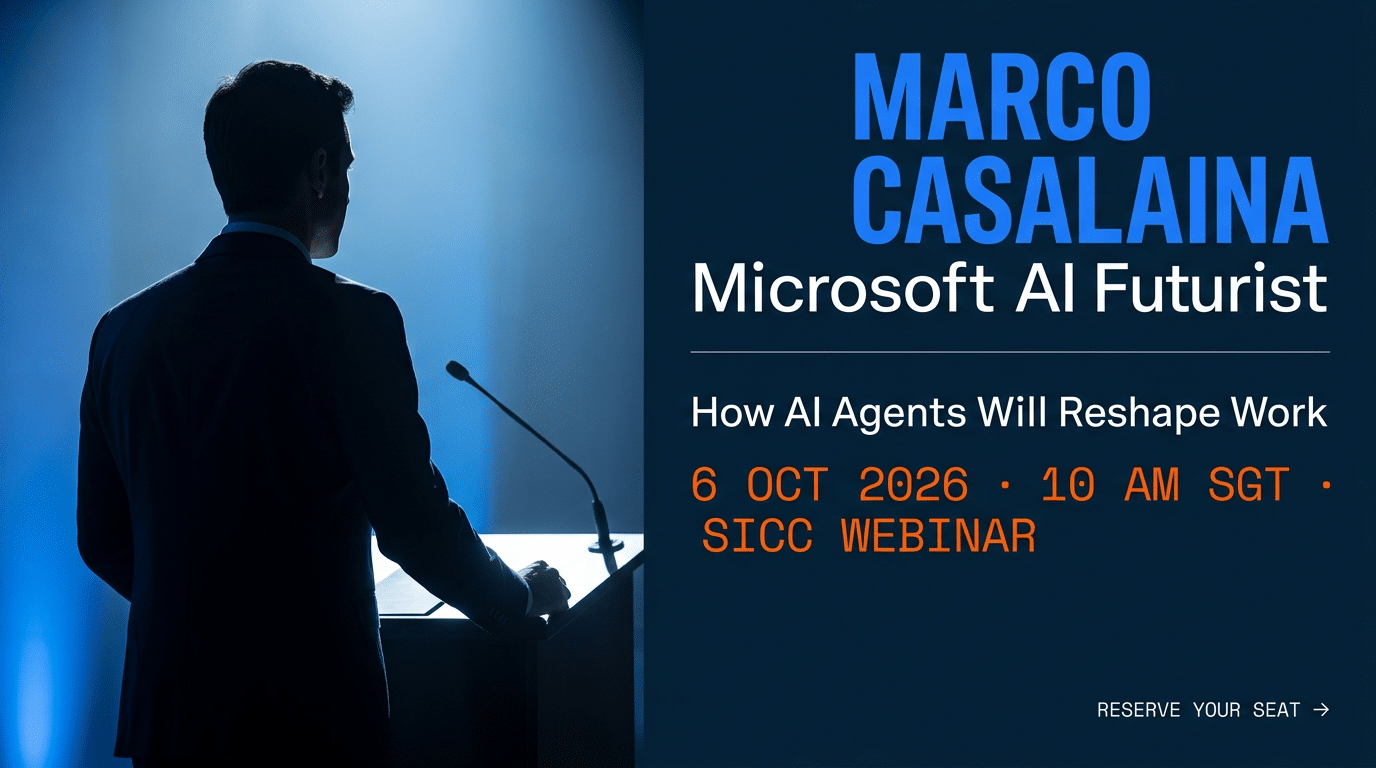
TL;DR: On 6 October 2026, 10:00–11:00 SGT, Marco Casalaina — VP Products, Core AI and official AI Futurist at Microsoft — takes the SICC virtual stage for a one‑hour session on how AI agents will reshape work, companies and careers in Singapore and globally. Thirty minutes of forward‑looking lecture from the person Microsoft literally pays to skate 12–24 months ahead of the market, then thirty minutes of unfiltered Q&A. If your 2027–2028 strategy has to survive contact with agentic AI, this is the highest‑signal hour on your calendar this quarter.
Why is this webinar worth ring‑fencing on your calendar?
Because you are not paying for information. You are paying for compression of the future.
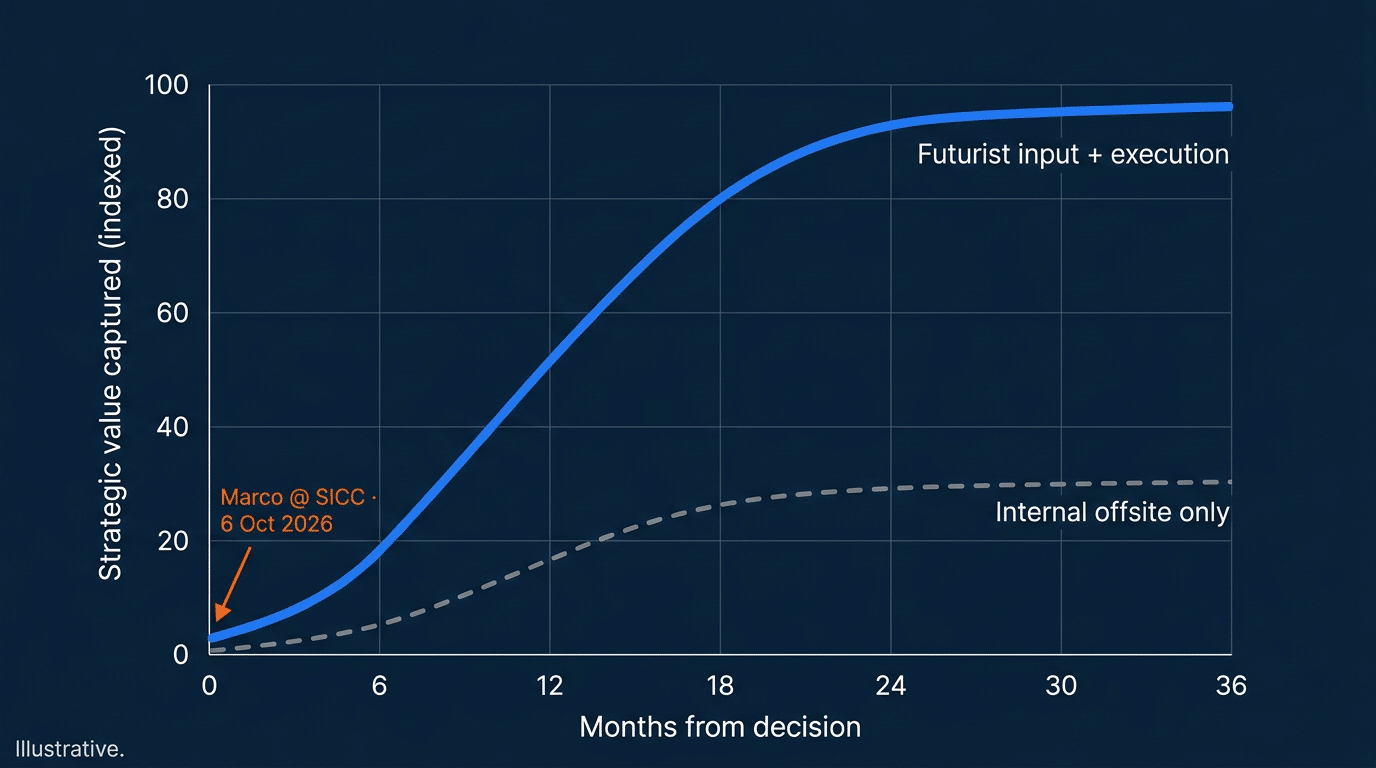
Marco’s title inside Microsoft is not a marketing flourish. “AI Futurist” is a functional role — he is the person Microsoft assigns to be “the first to try anything new,” leading the internal AI Futures team that identifies emerging trends and turns them into the next generation of Azure and Copilot products (Microsoft AI Tour speaker page, ESPC Conference bio). Before Microsoft, he ran Salesforce Einstein as SVP/GM — one of the world’s earliest and most widely deployed enterprise AI platforms — and Google Cloud’s AI applications team before that (LinkedIn profile).
Translation: you are getting a 12–36 month preview of the roadmap of one of the two largest AI and cloud companies on Earth, from the person whose job title is to see it first.
I am chairing this session in my capacity as the Chair of the SICC Tech Transformation Group. We built the Tech Transformation Group with a single rule: member‑proof only — hands‑on, demo‑led, and useful on Monday morning. Marco is a textbook fit. He does not do slideware. He runs live agents on stage — an agent buying an Xbox on the open web, Claude on Azure building a PowerPoint in HTML without ever opening PowerPoint, a “Magnus” agent booking a rental car and doing LinkedIn outreach autonomously (Microsoft Learn — Sip and Sync: Computer Use Agents, Microsoft Developer YouTube).
What exactly is on the agenda for 6 October?
Event: How AI Agents Will Reshape Work, Companies and Careers in Singapore and the World — Insights from Marco Casalaina, Microsoft AI Futurist
| Item | Detail |
|---|---|
| Date | Tuesday, 6 October 2026 |
| Time | 10:00 – 11:00 SGT (UTC+8) |
| Venue | Zoom (link on registration) |
| Format | 30 min lecture + 30 min live Q&A |
| Host | Singapore International Chamber of Commerce (SICC) — Tech Transformation Group |
| Chair | Jiri Pik (CEO, RocketEdge) |
| Speaker | Marco Casalaina, VP Products Core AI & AI Futurist, Microsoft |
By the end of the hour you will:
- Understand the concrete difference between AI assistants and AI agents — and why the second one changes org charts, not just workflows.
- See how AI is already reshaping jobs, org structures, and P&Ls at leading Microsoft, Salesforce and Fortune‑500 deployments.
- Learn which capabilities are becoming critical — and which are quietly becoming obsolete inside 24 months.
- Take away a working perspective on what Singapore’s AI transformation means for your firm’s next 12–36 months of strategy.
Bring your sharpest question. The second half of the hour is a live Q&A. Because we get one shot with a speaker of this calibre, we are collating and pre‑ranking questions from members and attendees in advance and sharing the shortlist with Marco.
Why does one hour with an AI futurist beat a week of internal strategy offsites?
Because the constraint on modern strategy is not analysis. It is priors. Two mental models make this concrete.
Mental model 1 — Bayesian priors. Strategy is a posterior distribution: P(strategy | evidence) ∝ P(evidence | strategy) · P(strategy). Most executive teams spend six months arguing over P(evidence | strategy) — the interpretation — because their P(strategy) prior is anchored to a stale 2023–2024 world model. One hour with someone whose day job is calibrating the prior on agentic AI does more for the posterior than a quarter of debate.
Mental model 2 — Wayne Gretzky’s puck. “Skate to where the puck is going, not where it has been.” The problem is that most executives have no reliable read on where the puck is going, so they skate to where the puck was and call it strategy. Marco’s job — literally — is to know where the puck is going in AI. Copying the vector is cheaper than deriving it.

Great operators have said versions of this for a century:
“The best way to predict the future is to invent it.” — Alan Kay, Xerox PARC.
“The future is already here — it’s just not evenly distributed.” — William Gibson.
“Skate to where the puck is going, not where it has been.” — Wayne Gretzky.
“In a time of drastic change it is the learners who inherit the future. The learned usually find themselves equipped to live in a world that no longer exists.” — Eric Hoffer.
Marco’s signature keynote for 2025–26 is literally titled “The Future of AI Is Already Here” — an 83‑minute Stanford guest lecture that has become the definitive primary source on agentic AI in the enterprise (Stanford Cloud Computing for Biology & Healthcare — YouTube). This webinar is a Singapore‑specific, compressed edition of that thesis — delivered live, with Q&A, and free to SICC members.
What is the “edge perspective” you will not hear from other AI speakers?
Here is the reframing almost no one has entertained yet — and the reason this session matters more than a generic AI keynote.
Agents do not sit inside the org chart. They are an org chart.
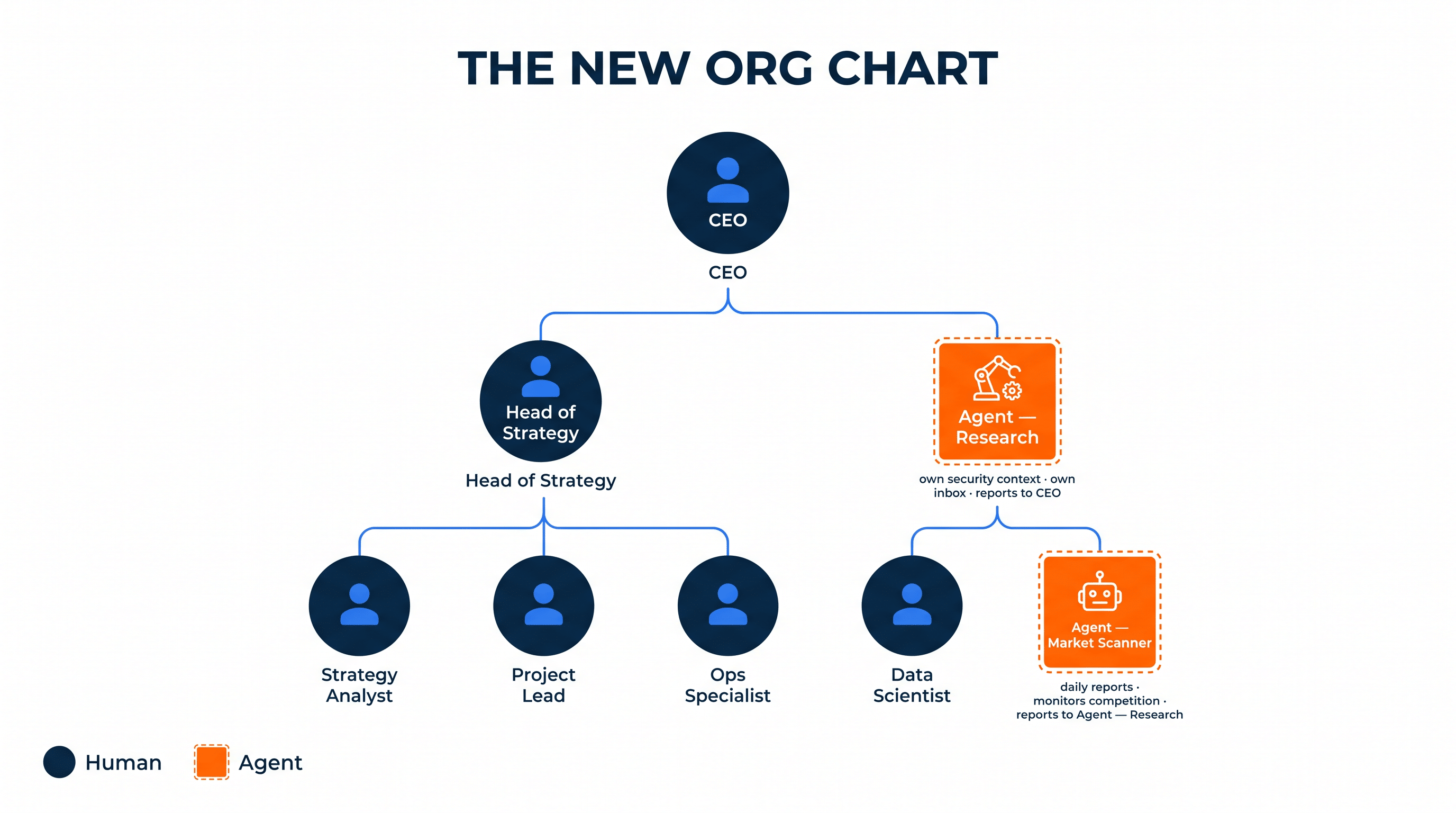
At Microsoft Build 2026, Marco introduced a framework almost no other vendor has yet operationalised: agents that run in their own security context, with their own permissions, email address, and Teams inbox, that literally appear on the org chart and report to a human manager (Microsoft Build 2026 — The Three IQs). Not “AI in your workflow.” AI as a peer node in your workforce topology, with an identity, a boss, and a paper trail.
Combine that with his other operating principle — “Planning is the new execution” (The Road to ECS podcast) — and the implication is second‑order and brutal:
- The bottleneck in the modern firm is no longer doing. It is deciding what to do, and verifying what agents did.
- The valuable middle manager of 2028 is not the one who dispatches humans — it is the one who hires, fires, promotes and audits agents.
- Which means every org design, every RACI matrix, every job description, and every SOC‑2 control written before 2026 is silently going out of date right now.
If that is even 40% correct, the cost of missing this session is not “an hour.” It is a strategic mispricing of your 2027–2028 operating model.
Why is SICC membership a strategic asset for any forward‑looking firm in Singapore?
The Singapore International Chamber of Commerce, founded in 1837, is one of the oldest chambers of commerce in Asia and one of the few that consistently gets the country’s most senior policymakers in the same room as its members (SICC).
For any CEO, CTO, or country manager operating out of Singapore, the practical return on SICC membership sits in four buckets:
- Direct access to Cabinet‑level and ministerial dialogue. SICC regularly hosts sessions with Ministers, Permanent Secretaries, MAS and EDB leadership where members can ask any question — on the record, in person. You see the direction of national policy — AI, talent, tax, capital flows, decarbonisation — 6–18 months before it shows up in the Straits Times.
- Peer network of executives who actually decide. Not “networking events” — working groups with sitting CxOs of MNCs, family offices, banks, and fast‑scaling technology firms. Deals, hires, and co‑investments come out of these conversations.
- Sector resource groups with real output. The Tech Transformation Group (which I chair), Sustainability, Financial Services, Trade & FTA, and HR groups produce briefings, position papers and closed‑door sessions like this one — often with speakers no single company could book alone.
- A neutral platform. SICC is nationality‑agnostic. In a fragmenting geopolitical environment, it is one of the few forums where American, European, Chinese, Indian and ASEAN firms operate as equal members.
If your business decisions depend on knowing where Singapore is heading before your competitors do, SICC is not a nice‑to‑have. It is table stakes. Membership details →
Why is Singapore the correct place to have this conversation at all?
Because the geography of the business world moves once a century, and it is moving again — right now, right here.

London was the capital of the business world in the 19th century. The City financed empire, invented modern insurance (Lloyd’s, 1688 → institutional in the 1800s), set the gold standard, and cleared roughly half of global trade credit through Lombard Street.
New York was the capital of the business world in the 20th century. Post‑1945 dollar hegemony, Wall Street’s post‑Bretton‑Woods dominance, the rise of the Fortune 500, venture capital, and the deepest capital markets ever built.
Singapore is aiming to be the capital of the business world in the 21st century — a century that will be defined, structurally, by the rise of Asia. Asia already accounts for the majority of global GDP growth (IMF World Economic Outlook), and the next decade layers AI, semiconductors, energy transition and data infrastructure on top of that base. Singapore has quietly positioned itself as the neutral, rule‑of‑law, English‑and‑Mandarin, AI‑ready hub for that entire flow — from Smart Nation to AI Verify to the National AI Strategy 2.0.
The analogy is instructive — and it has limits. London ruled trade finance; New York ruled capital markets; Singapore’s play is different — a coordination hub for an Asia that is not monolithic. That is a harder game and a more valuable one, precisely because it cannot be won on scale alone. It has to be won on trust, neutrality, speed, and technology. Sessions like this one are how you keep score.
What has Marco actually built and said — the receipts
You are not being asked to trust a bio. Marco has an unusually thick public track record. Sample:
- “The Three IQs: Ground Your Agents in Knowledge, Data, and Work” — Microsoft Build 2026, LIVE171. Introduces the Web IQ / Foundry IQ / Fabric IQ / Work IQ retrieval framework and agents that report on the org chart. Watch.
- “The Future of AI Is Already Here” — Stanford guest lecture, 20 Jun 2025, 83 min. The single deepest primary source on his worldview. Watch.
- “Multimodal, Multimodel & Multiagent Innovation with Azure AI” — Microsoft Build 2024, BRK104. Live GPT‑4o vision, Phi‑3 in the browser, an OpenAI agent autonomously writing Python. Watch.
- “Computer Use Agents for Fun and Profit” — Microsoft Learn, Feb 2025. One of the earliest CUA demos in the industry. Watch.
- “Building for General Purpose AI Agents” — Sep 2025. “Businesses are going to have to optimise for agents.” Watch.
- “Applied AI: Copilots in the New World” — FiRe Conference, 2024. On LLMs as “hallucination machines by design” and how to engineer around it. Watch.
The through‑line is consistent: ubiquitous, multimodal, autonomous. Three vectors. He has been right about all three, on the record, for four years.
What should you actually do between now and 6 October?
- Register today — seats on Zoom webinars fill in tiers; early registrants get the calendar hold, the reminder sequence, and the follow‑up recording.
- Submit your sharpest question by 3 October — we will collate, deduplicate and pre‑rank member questions and share the shortlist with Marco 48 hours before the session.
- Bring your top‑3 team members. The people who need this most are the ones building your 2027 operating plan — CTO, COO, Chief of Staff, Head of Strategy, and anyone whose title has “Transformation” in it.
- Watch the Stanford lecture (link) as pre‑read. You will get 3–5x more out of the live hour if you already know the vocabulary.
- If you are not yet an SICC member — start the membership conversation now. This session is one of many. The strategic value is the compound one.
FAQ
Who is Marco Casalaina and why should executives listen?
Marco is Microsoft’s VP of Products, Core AI and official “AI Futurist,” leading the AI Futures team that identifies emerging AI trends and shapes Azure’s next‑generation products. He previously ran Salesforce Einstein and Google Cloud AI applications. He is one of the few speakers who runs live agent demos on stage rather than slideware.
What will I actually learn in 60 minutes?
The concrete difference between AI assistants and AI agents, how agents are already reshaping org design at leading Microsoft/Fortune‑500 deployments, which skills and capabilities are becoming critical in the next 24 months, and how Singapore fits into the global AI transformation map.
How does the session work?
30 minutes of forward‑looking lecture from Marco, followed by 30 minutes of live audience Q&A. Questions can also be submitted in advance — we will collate the strongest ones and share them with Marco 48 hours ahead so you get maximum airtime.
Do I need to be an SICC member to attend?
The session is a SICC Tech Transformation Group event; access rules are set by SICC. Non‑members can typically attend selected sessions, but member access is broader and includes the full year of ministerial dialogues, working groups and closed‑door briefings. See SICC membership.
Will there be a recording?
Yes — registered attendees receive the recording. Live attendance is recommended for the Q&A, which is the highest‑signal portion of the hour and cannot be reconstructed from the recording.
About RocketEdge: RocketEdge builds AI‑powered trading infrastructure for institutional and professional traders in APAC and globally. Our products — MultiEdge AI Signal Fabric, Agentic Research Platform, and AI Trade Idea Generator — are available on Azure Marketplace. Jiri Pik, CEO of RocketEdge, is Co‑Chair of the SICC Tech Transformation Group. → Book a 30‑minute Strategy Call