
TL;DR: Signal as a Service is the moment trading-signal distribution stops being a Telegram channel or a bespoke webhook script and becomes neutral, auditable infrastructure — what SWIFT did for payment messages in 1973 and FIX did for orders in 1992. MultiEdge Signal Relay, built by RocketEdge in Singapore, is the first purpose-built rail for that job: publish once, every institutional subscriber receives, a per-attempt ledger proves who got what and when, and sealed mode makes the relay structurally unable to read what it carries. This post explains who it is for, why now, and what “provably delivered” means in code.
What is Signal as a Service, and why does the era start now?
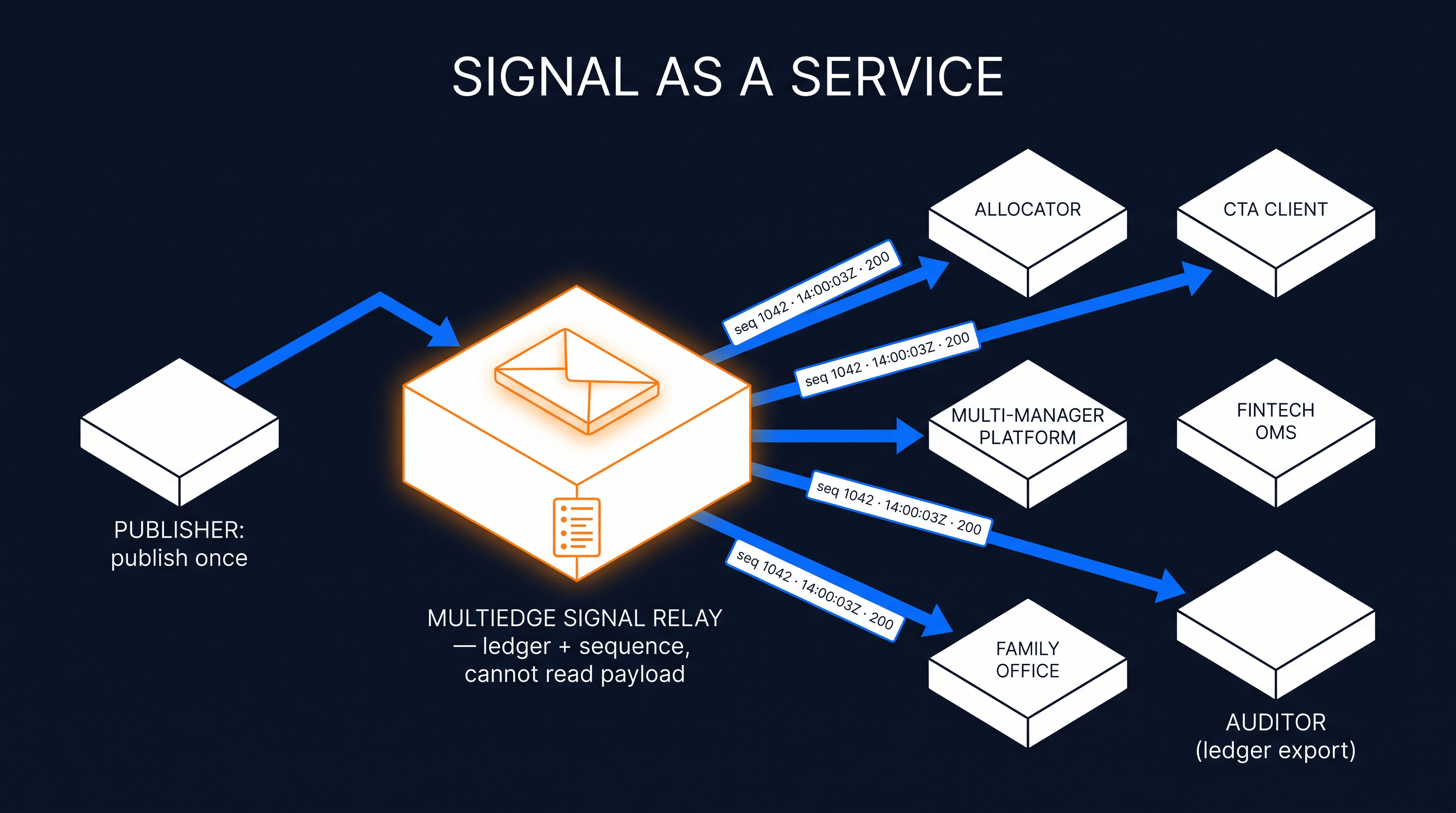
Signal as a Service is signal distribution delivered as metered infrastructure with delivery guarantees, rather than as a side-effect of whatever chat tool the strategist had open. Concrete example: a CTA publishes one month-end rebalance for its trend program; twelve allocators receive it within seconds, each delivery is sequenced and logged, and if allocator number nine was offline for the weekend, its subscriber resumes from a persisted cursor on Monday and misses nothing. One publish call. Nobody forwarded a screenshot.
The phrase “sell signals as a service” has floated around retail fintech for years, but the retail version never had the two properties that make a service institutional: evidence and neutrality. MultiEdge Signal Relay entered production in August 2026 as auditable signal-distribution infrastructure that carries signals and never executes trades, with a first production end-to-end run on 16 August 2026 (multiedge.ai). To our knowledge it is the first commercial rail where the carrier keeps a neutral, exportable, per-attempt delivery ledger and can be configured so that it cannot read the payload at all. That combination is what turns a feature into an era.
The closest analogy is Twilio, which in November 2008 launched an API that let developers recreate a telephony product “in 15 lines of code” instead of building carrier integrations (TechCrunch). The analogy holds for the abstraction — publish once, let the rail fan out — and breaks on content: a phone call is commoditised, a signal is somebody’s alpha. That is why the relay must prove delivery and must be unable to inspect content; Twilio needed neither.
Why do trading signals still travel like it is 2009?
The stated cause, heard on nearly every desk we speak to, is: “Distribution isn’t our bottleneck. Alpha is.” The actual causes are three, and each deserves its own verdict.
Actual cause 1 — unverifiable delivery destroys commercial trust. When a subscriber says “we never received the 14:00 rotation,” the publisher today produces its own server log. A self-kept log is self-attestation; a neutral third-party ledger is evidence, as MultiEdge puts it. Verdict: holds. Every signal contract dispute we have seen turns on this.
Actual cause 2 — “our engineers can build this in a week.” They can build the webhook fan-out in a week; that is the easy 95%. The hard 5% — idempotent publish, gapless sequencing, cursor replay, retry ladders ending in explicit dead letters, HMAC verification, key management — is what published build-versus-buy analyses put at 18–60 engineer-months to build and $18K–60K per month to operate before any audit hardening (multiedge.ai/pricing). Verdict: partial. The week is real; the product is the other 5%.
Actual cause 3 — compliance cannot audit a chat channel. An allocator’s operational due-diligence team asks: who received this signal, at what timestamp, with what response code, and can you prove nobody was favoured? Telegram has no answer, and neither does an in-house script with a rotating log file. Verdict: holds. The relay’s ledger is exported to write-once storage and retained for five years (multiedge.ai/compliance).
The real solution follows from the diagnosis: separate the signal from its transport, make the transport neutral and evidential, and keep execution in the subscriber’s own code. That is the entire product thesis, and it is the move payments made fifty years ago.
What did SWIFT and FIX teach us about neutral rails?
In 1973, 239 banks from 15 countries founded SWIFT because telex — the chat tool of its day — was insecure and manual (SWIFT). The design decision that mattered most is the one people forget: SWIFT’s “primary role is that of a message carrier” — it moves messages, never money (LSE). Neutral carriage, not settlement, is what let competitors share one rail.
In 1992, Fidelity and Salomon Brothers started FIX because firms were “building proprietary, point-to-point interfaces with each counterparty,” which did not scale (FIX Trading Community). Both precedents share a structure: the era began when the plumbing became boring, standardised, and auditable — not when the payments or the orders got smarter. Signal Relay’s motto, “infrastructure, not execution,” is the same posture applied to alpha (multiedge.ai/compliance).
The limits of the analogy: SWIFT is a member-owned cooperative with near-monopoly network effects; MultiEdge is a vendor with an Apache-2.0 SDK and no standards body behind it. FIX standardised a message format; the relay standardises delivery guarantees and leaves the payload schema to you, shipping portfolio_rebalance/1.1 as the default and carrying arbitrary JSON opaquely under your own registered schema (GitHub). The precedent tells you the direction of travel, not the market structure at the end of it.
Who needs Signal as a Service — and who does not?
Signal as a Service is for three groups, and the boundary is drawn by the word “institutional.” Publishers: hedge funds, CTAs, and quant strategists who deliver systematic signals to external professional clients and need proof of delivery. Subscribers: allocators, multi-manager platforms, and family offices that consume several external strategies and want one cursor-resumable feed instead of six ad-hoc integrations. Fintech platforms: teams building institutional research or execution tooling that need a compliant signal rail rather than another pub-sub cluster to babysit. Access is KYB-gated and institutional-only; there is no marketplace, no rankings, and no performance claims (multiedge.ai).
The driving force is secular. An AIMA/SS&C survey of 100 managers with about $720 billion in AUM found 53% already using alternative data and 14% trialling it; Neudata put average spend near $1.6 million per firm per year and industry spend near $2.8 billion in 2025; the share of funds mixing in-house and vendor data rose from 68% to 77% (multiedge.ai). Signals are becoming a purchased input, and purchased inputs need receipts.
The cyclical accelerant is crowding. SG Trend Index constituents showed 0.78 pairwise correlation in 2024 and the broad CTA index tracked the trend sub-index at 0.97, so allocators are hunting for uncorrelated external streams — and by Grinold’s fundamental law two uncorrelated streams add roughly 1.4x the information ratio of one (multiedge.ai). That hunt needs a rail.
| Channel | Delivery evidence | Idempotent publish | Replay after outage | Relay can read payload | Cost model |
|---|---|---|---|---|---|
| Telegram / Slack / email | None per recipient | No | Manual scroll-back | Yes | Free, and priced accordingly |
| In-house webhook fan-out | Whatever you build | If you build it | If you build it | Yes | 18–60 engineer-months, then $18K–60K/mo (pricing) |
| MultiEdge Signal Relay | Per-attempt ledger, 5-year write-once export | client_signal_id, 409 on changed payload | 90-day window, cursor gap-fill | No, in sealed mode | Sandbox free 7 days; Production from $1,495/mo (pricing) |
Who does not need it: retail signal sellers, anyone who wants the rail to rank or endorse strategies, and anyone who wants someone else to place their orders. The relay refuses all three by design.
What does “provably delivered” look like in code?
Idempotency means a retried request produces one signal, not two — client_signal_id is the key, a byte-identical resend returns HTTP 200 with duplicate=True, and a changed payload under a reused ID is refused with HTTP 409 (GitHub). At-least-once delivery means the relay never drops a signal but may redeliver after a crash; exactly-once processing means the SDK’s local SQLite ledger runs your handler once per signal_id regardless (multiedge.ai/docs). The whole contract, publisher and subscriber, adapted from the official walkthrough:
# uv add multiedge-relay   (Python 3.11+, Apache-2.0)
from multiedge_relay import Signal, SignalPublisher, SignalSubscriber, SqliteStateStore

# --- Publisher: one call, three explicit outcomes -----------------------------
relay = SignalPublisher(api_key="mesk_...")          # retries + disk DLQ are automatic
ack = relay.publish(Signal(
    strategy_id="str_trend_program",
    client_signal_id="str_trend_program:2026-09-30",  # deterministic -> safe to retry
    payload=rebalance,                                # whole book; omission = liquidation
))
print(ack.sequence, ack.duplicate)   # gapless sequence; True if the relay had seen the ID

# --- Subscriber: resume from cursor, process exactly once ---------------------
store = SqliteStateStore()           # ~/.multiedge/state.db — cursor + dedup ledger, stdlib only

def handle(signal, meta):
    route_to_oms(signal)             # your execution, your guardrails — the relay never trades

sub = SignalSubscriber(api_key="mesk_...",
                       strategy_id="str_trend_program",
                       on_signal=store.exactly_once(handle),   # once per signal_id
                       cursor_store=store)
sub.run()                            # catch up from cursor (90-day window), then live
Behind that call sit the guarantees that make the ledger meaningful. Webhooks are HMAC-SHA256-signed over "{unix_ts}." + raw body with constant-time comparison and a five-minute freshness window; failed deliveries climb a six-attempt retry ladder — +30 s, +2 m, +10 m, +1 h, +6 h, roughly 7.5 hours — then land in an explicit dead-letter queue, every attempt’s timestamp, endpoint, status, and response recorded (multiedge.ai/docs). Design targets are under 250 ms p95 publish-ack to same-region WebSocket delivery and under 500 ms cross-region; the first production run measured about 1.5 s, a single-run figure the team publishes rather than rounds away (multiedge.ai).
Sealed mode is the part that changes who will trust the rail. Payloads are encrypted client-side with a fresh 256-bit ChaCha20-Poly1305 key per signal, wrapped per recipient with hybrid X25519 + ML-KEM-768 (NIST FIPS 203), and dual-signed Ed25519 + ML-DSA-65 (FIPS 204), so the relay sees IDs, sequence numbers, timestamps, and size — never content (multiedge.ai/docs/sealed). The analogy is a registered-mail courier who cannot open the envelope; its limit is that the courier still knows who wrote to whom and when, and sealed mode says so plainly.
The edge perspective: the ledger is the product, the pipe is the packaging
Here is the view nobody in this market has put in writing: a signal that cannot prove its own delivery has a commercial value of zero the moment it is disputed, regardless of its Sharpe ratio. Apply inversion — ask what would make a brilliant signal worthless — and the answer is not decay, it is an allocator who can credibly say “we never got it.” Every signal business is a receipts business wearing an alpha costume.
Two named mental models make the case rigorous. Grinold’s fundamental law: premises — information ratio scales with the square root of breadth, and breadth for an allocator now means the number of uncorrelated external streams it can operate; reasoning — each stream costs an integration, and integration cost caps breadth; conclusion — a rail that makes the marginal stream nearly free raises the ceiling on achievable information ratio. Base rates: premises — 97 published predictors returned 26% less out-of-sample and 58% less post-publication (Journal of Finance), so signals must be rotated; reasoning — rotation is viable only if onboarding is cheap and delivery auditable; conclusion — the distribution layer, not the research layer, is the binding constraint on how many signals an allocator can run.
The second-order effect follows. Once delivery is provable and content is sealed, a signal contract can be priced on attested delivered messages rather than on trust — MultiEdge lists exactly that attestation on its roadmap from $750 per month (multiedge.ai/pricing). That flips strategist and allocator from “believe us” to “audit us,” the same flip that turned correspondent-banking favours into a neutral rail now carrying about 44 million messages a day (Investopedia). The era of Signal as a Service is not about better signals; it is about the first neutral witness in a market that never had one.
Alternative Perspectives
“Serious funds will never send alpha through a third party.” True for plaintext rails, which is why sealed mode exists: the relay carries ciphertext it cannot open, with keys pinned out-of-band so it is untrusted even as a keyserver (multiedge.ai/docs/sealed). The objection is to a trust model, not to a rail.
“This is just Kafka with a compliance PDF.” Partially fair — the fan-out is commodity. Kafka does not ship an exportable per-attempt ledger, KYB-gated tenants, or post-quantum envelopes, and nobody’s auditor accepts a consumer-group offset as proof a counterparty received a message. The differentiating layer is exactly the part Kafka leaves to you.
What this means for your desk
- If you publish signals: stop shipping alpha over channels that cannot testify. Run the free seven-day sandbox, publish one strategy with deterministic
client_signal_ids, and export the ledger for your compliance officer (multiedge.ai/docs/sandbox). - If you allocate to external strategies: make cursor-resumable, ledgered delivery a due-diligence requirement, the way you already require independent administrators.
- If you build fintech infrastructure: keep execution in your code and rent the evidence layer; the IBKR walkthrough shows a subscriber turning a delivered target weight into a paper-account order through your own hard limits.
- If you are a CTO deciding build versus buy: budget the hard 5% honestly against a Production tier from $1,495 per month (multiedge.ai/pricing).
This launch rests on the same discipline behind our AI trading infrastructure work with Microsoft, our view that cybersecurity and trading infrastructure are converging, and our insistence that backtests earn trust through validation, not narrative. The relay does not make a signal good. It makes a good signal provable, and in an institutional market that is the difference between a hobby and a business.
FAQ
What is Signal as a Service?
Signal as a Service is trading-signal distribution delivered as metered infrastructure with guarantees — idempotent publishing, sequenced at-least-once delivery, cursor replay, and an auditable per-attempt ledger — instead of ad-hoc channels such as chat groups or email. MultiEdge Signal Relay is the first institutional rail built for this purpose.
Does MultiEdge Signal Relay execute trades or recommend strategies?
No. It is infrastructure, not execution: it carries signals from publishers to entitled institutional subscribers and never places orders, ranks strategies, or makes performance claims (multiedge.ai/compliance). Execution stays in the subscriber’s own code.
How does the relay prove a signal was delivered?
Every delivery attempt is written to a ledger with timestamp, endpoint, status, and response, exported to write-once storage and retained for five years (multiedge.ai/compliance). Webhooks carry HMAC-SHA256 signatures with replay protection, and a six-attempt retry ladder ends in an explicit dead-letter record rather than silent loss.
Can MultiEdge see my signals?
Not on a sealed strategy. Sealed mode encrypts payloads client-side with post-quantum hybrid cryptography (X25519 + ML-KEM-768, ChaCha20-Poly1305, Ed25519 + ML-DSA-65), so the relay stores and forwards ciphertext and sees only metadata such as IDs, sequence numbers, timestamps, and size (multiedge.ai/docs/sealed). Sealed strategies support roughly 100 recipients today.
What does MultiEdge Signal Relay cost?
Sandbox access is free for seven days on synthetic data, a 90-day design-partner engagement is $3,000, Production starts at $1,495 per month with five subscribers and 100k deliveries included, and Regulated/Enterprise tiers start at $4,000 per month with dedicated tenancy (multiedge.ai/pricing). Institutional and professional participants only.
About RocketEdge: RocketEdge builds AI-powered trading infrastructure for institutional and professional traders in APAC and globally. Our product family on multiedge.ai — MultiEdge Signal Relay (live), with MultiEdge.ai Signals, the Agentic Research Platform, and the AI Trade Idea Generator in development — is engineered on Azure by practitioners who have shipped low-latency trading, risk, and market-data systems at global banks. → Book a 30-minute Strategy Call
Disclaimer: Past performance is not indicative of future results. This content is for informational purposes only and does not constitute financial, legal, or investment advice. MultiEdge Signal Relay provides message-distribution infrastructure only; it does not execute trades, recommend strategies, or make performance claims. Latency figures are design targets or single measured runs as stated, not guarantees. Product facts reflect multiedge.ai documentation and pricing as published on 21 September 2026 and may change.