
TL;DR: The dangerous state of an Interactive Brokers connection is not “disconnected” — it is “connected and wrong”: the gateway reports healthy while prices have stopped updating or a modified order has quietly become two live orders. Uptime cannot see this class of failure, so IB Gateway reliability has to be measured in time-to-truth — the seconds between the broker’s state diverging from your system’s belief and your system knowing it. We show the failure modes, the documented causes, and the engineering pattern that detects them in under 90 seconds without ever touching your credentials.
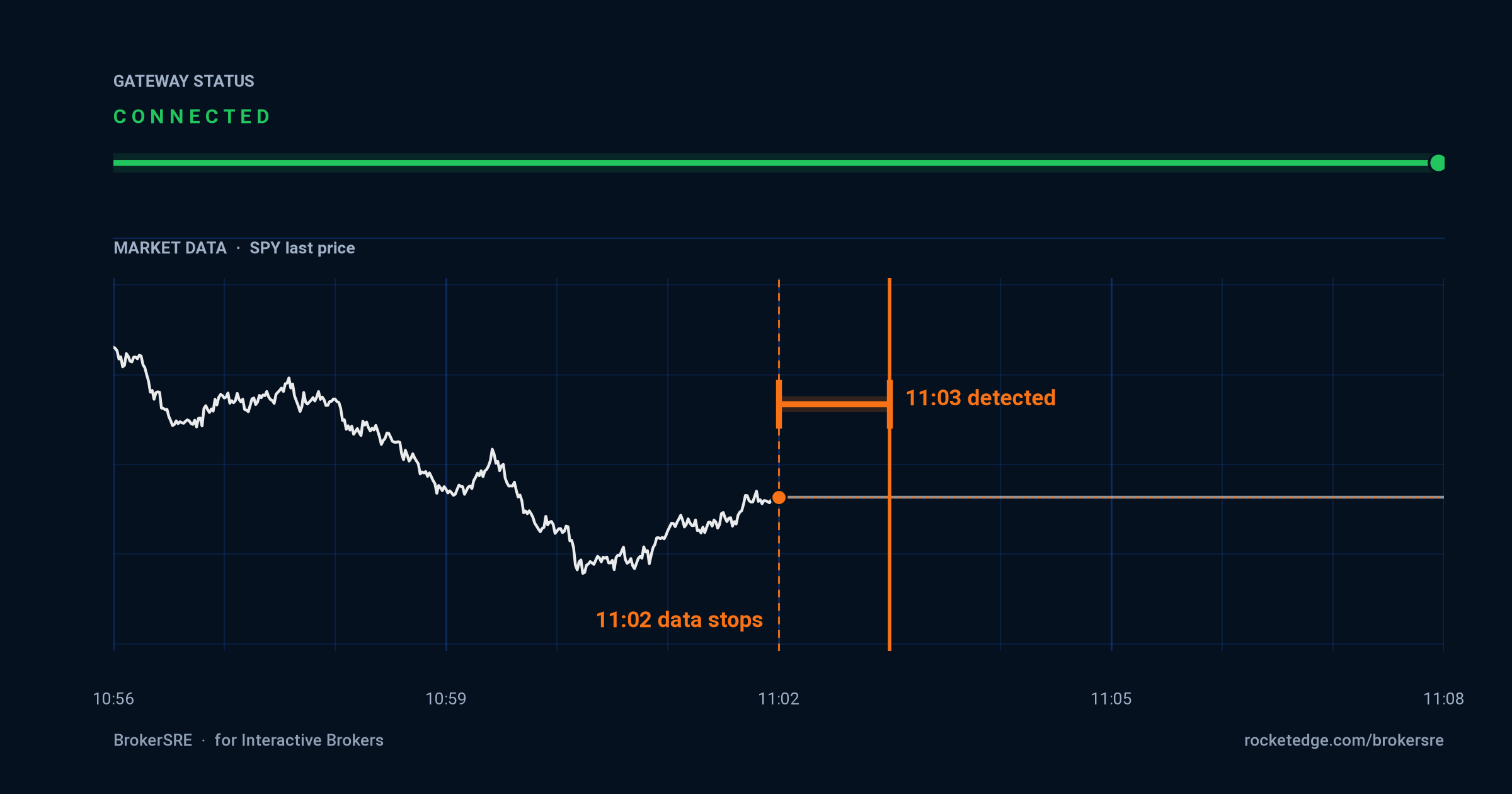
Why does a “connected” IB Gateway lose money?
Every automated desk on Interactive Brokers has the same dashboard tile: a green dot that says Connected. That tile is the problem. IB Gateway — IBKR’s headless Java process that terminates the TWS API socket — can be connected, authenticated and completely wrong about the world, and nothing in the protocol tells you.
Three documented incidents define what we call the Up-and-Wrong class of failures:
| Failure mode | What the uptime tile shows | What actually happened | Source |
|---|---|---|---|
| Silent stale data | Connected | After a reconnect the market-data stream died while prices stayed visible; an algorithm “traded all afternoon using a price last updated at 11 AM” | Concretum Group |
| Ghost order | Connected | A modify sent during degraded connectivity came back as a second working order with a new permId; the original was cancelled, the ghost filled four contracts. Fixed in Nautilus Trader only on 8 Oct 2026 | Nautilus issue #4564 |
| Crossed MOC | Connected | Two strategies in one account sent opposing market-on-close orders; IBKR rejected one with error 202 “Order would cross” and the book went unhedged into the auction | Concretum Group |
A permId is IBKR’s permanent server-side identifier for an order; your orderId is only a client-side handle. When one client order maps to two permIds, the broker has two live intentions and you have one — that is the ghost.
Measure these with uptime and you get a perfect score. One practitioner reports 99.2 % uptime on an IB Gateway daemon since December with a single restart for an IB Key refresh (Supa.is). That number is real and it is irrelevant: none of the three incidents above would have dented it.
What really causes IB Gateway reliability failures?
The stated cause, heard on every desk, is “the IBKR API is flaky.” Diagnosing intent properly means testing that claim against the actual drivers.
Candidate 1 — The session model is the problem. IBKR designs TWS and Gateway to restart daily, the weekly re-authentication cycle starts every Monday, and a Soft token=0 login failure needs a human (IBKR docs). A username holds exactly one brokerage session across every IBKR surface (IBKR). Verdict: holds — but it is documented behaviour, not flakiness. Flakiness is what you call a contract you did not read.
Candidate 2 — Client-side state assumptions are the problem. Strategy code keeps its order book in memory and treats the socket as the source of truth. After a reconnect, in-memory state is a map; the broker is the territory (the map-versus-territory model). Every Up-and-Wrong incident is a map trusted after the territory moved. Verdict: holds, and it is the dominant cause.
Candidate 3 — Nobody owns operations at small funds. IBKR reserves relationship managers and margin specialists for “large, active” funds, undefined on its own page (IBKR Hedge Fund). Trading VPS vendors state plainly that “IBKR’s restart and reauthentication rules still apply.” Hedge-fund IT MSPs run e-mail and endpoints at USD 275–400 per user per month (Triada); none of them touch the broker session. Verdict: holds — the ops seat is structurally empty.
Candidate 4 — IBKR is an unreliable broker. IBKR publishes reset windows and maintenance on a status page and the exchanges keep matching while your gateway is confused. Verdict: fails. The broker is up; your belief about the broker is down.
Who benefits from the “flaky API” narrative? Everyone selling a bigger box. Cui bono points at the VPS tier list, not at the socket.
What do Three Mile Island and Knight Capital teach about broker sessions?
On 28 March 1979 a pilot-operated relief valve at Three Mile Island stuck open; the control-room instrumentation did not reveal it, so operators believed coolant was being retained while the core drained (NRC Backgrounder). The indicator showed that the close command had been sent, not the valve’s actual position. That is a green Connected tile in a reactor.
On 1 August 2012 Knight Capital’s SMARS router processed 212 small retail orders and turned them into millions, obtaining over four million executions in about 45 minutes and losing more than USD 460 million (SEC Order 34-70694). Every server was up. One was wrong.
Where the analogies break: a reactor has no safe state you can reach by cancelling orders, and Knight’s failure was a deployment, not a session. What transfers is the mechanism — an indicator reporting what was commanded instead of what is true, and humans trusting it because it was green.
Zoom out and the forces are secular, not cyclical. Brokers are pushing headless authentication (IBKR’s OAuth 2.0 Web API and FIX routes), mandatory two-factor login is universal and non-negotiable — IBKR “does not allow users to partially or fully opt out” (IBKR) — and allocator due-diligence questionnaires now ask how you track open positions and recover from failure. Layer on the cyclical driver — AI coding agents letting one quant ship five fragile bots in a week (the second-order effect of cheap code is more sessions to keep truthful) — and the empty ops seat becomes the binding constraint on the whole desk.
How do you engineer IB Gateway reliability without touching credentials?
Apply inversion: what would guarantee failure? Measuring uptime, trusting Connected, letting strategies hold their own truth, and automating away the IB Key prompt. Each is common. Each is wrong, and the last one breaches IBKR’s customer agreement, which bars anyone from accessing the account unless IBKR is notified and agrees (IBKR Customer Agreement).
Then apply the theory of constraints: the IB Key holder is the bottleneck in the weekly cycle. Do not remove the constraint — exploit it. IBC, the open-source controller that drives Gateway without a human at the screen, re-issues the login after the three-minute 2FA timeout as many times as needed until the alert is acknowledged (IBC user guide); your job is to make the prompt impossible to miss, not impossible to need.
The pattern we run has four parts:
- Session choreography. Gateway in a pinned container with IBC; daily restart scheduled outside IBKR’s reset windows; a voice-call, SMS and Teams ladder to the IB Key holders at the weekly window, escalating at 10 and 30 minutes.
- Truth probes every 15 seconds. API round-trip, canary market-data staleness, clock drift against the broker clock, pending-2FA and competing-session detection from the Gateway logs, pacing and reject counters.
- Reconcile on every reconnect and every close. Open orders, executions, positions and cash pulled from the broker and diffed against the strategy’s recorded intent — never against memory.
- Credentials stay with the client. The deployment lives in the client’s Azure tenant; the operator works through an Azure Lighthouse delegation, which is control-plane only and cannot carry Owner or data-plane roles, so the operator physically cannot read the IBKR secret in the client’s Key Vault (Microsoft Tech Community).
Here is the heart of parts 2 and 3 in ib_async, the maintained successor to ib_insync:
# ib_async >= 2.0 — illustrative excerpt: staleness guard + reconcile-on-reconnect
import time
from collections import defaultdict
from ib_async import IB, Stock

STALE_S = 60                                  # RTH threshold; relax off-session via an exchange calendar
ib, last_tick = IB(), time.monotonic()

def on_tick(_):                               # any canary update resets the clock
    global last_tick
    last_tick = time.monotonic()

def data_is_live() -> bool:                   # strategies gate every order on this
    return time.monotonic() - last_tick < STALE_S

def reconcile(intent: dict[str, int]) -> dict:  # intent = orderRef -> qty from YOUR order log
    by_ref = defaultdict(set)
    for t in ib.reqAllOpenOrders():           # broker truth, never in-memory belief
        by_ref[t.order.orderRef].add(t.order.permId)
    return {
        "ghost":   {r: p for r, p in by_ref.items() if len(p) > 1},  # one orderRef, two live permIds
        "orphan":  set(by_ref) - set(intent),                        # working at broker, unknown to you
        "missing": set(intent) - set(by_ref),                        # you believe working; broker says no
    }

ib.connectedEvent += lambda: print(reconcile(load_intent()))        # on EVERY (re)connect
ib.connect("10.0.1.10", 4001, clientId=900)
canary = ib.reqMktData(Stock("SPY", "SMART", "USD"), "", False, False)
canary.updateEvent += on_tick
orderRef is the free-text tag you attach to every order; make it deterministic (strategy:signal_id:attempt) and the reconcile becomes a join, not a guess. The full agent adds the calendar, the kill-switch and the evidence store; the excerpt is the idea.
What does time-to-truth look like in numbers?
Time-to-truth (TtT) is the elapsed time between the moment broker state diverges from your system’s belief and the moment your system knows. Uptime asks “is the socket open?”; TtT asks “how long were we wrong?” These are the design targets we hold the pattern to — targets, not measured client results:
| Signal | Detection target | Mechanism |
|---|---|---|
| Dead gateway or API session | ≤ 60 s | 15 s probe, three misses |
| Dead market-data stream during RTH | ≤ 90 s | Canary staleness guard |
| Pending 2FA | immediate alert; auto re-prompt every 3 min | IBC relogin loop + action group |
| Clock drift | ≤ 250 ms | Broker-clock comparison; MOC orders cannot be entered after 15:50 ET, so a late clock is a rejected hedge (Concretum Group) |
| Order-state divergence | ≤ 1 reconnect | Reconcile diff |
The rate limits set the probe budget: the TWS API accepts at most market-data-lines ÷ 2 messages per second — 50 per second at the default 100 lines (IBKR) — and the Web API caps at 10 requests per second per username (IBKR). Probes that ignore this become the outage they were meant to detect.
Alternative Perspectives
“Buy FIX and the problem disappears.” Above USD 1,500 per month in commissions — IBKR’s minimum for a first FIX session (IBKR FIX) — FIX does remove the weekly re-login. It does nothing for state integrity: QuantConnect temporarily disabled its IBKR FIX route after an account-mapping bug caused live orders to be rejected (QuantConnect). Different pipe, same map-versus-territory gap.
“Let a platform own it.” Hosted platforms genuinely remove the ops seat for their native users. They also move the dependency rather than ending it, and an allocator’s questionnaire still asks you who is accountable and how you proved it.
How RocketEdge approaches this
We productised the pattern as BrokerSRE for Interactive Brokers: a scored audit of a live IBKR stack against 174 production rules, a fixed-price deployment into the client’s own Azure tenant, and a monthly run tier that reports SLO attainment and error budget. It observes, reconciles and alerts; it never places orders and never holds a credential. The same checklist runs our own MultiEdge Signal Relay in production.
What this means for your trading desk
- Delete the uptime tile. Replace it with last-tick age, clock drift, open-order diff and a 2FA-pending flag.
- Make
orderRefdeterministic today; it costs one line and turns every reconnect into an auditable join. - Schedule the daily restart outside IBKR’s published reset windows and put the weekly IB Key prompt on a calendar with two named holders.
- Gate every order on
data_is_live()and on an empty reconcile diff — the same discipline we argued for in Agentic Trading in 2026: adaptation loops need truthful inputs. - Write the incident you have not had yet. If a modify during a blip became two orders at 15:48 ET, who would know, when, and what would they do?
FAQ
Why does IB Gateway disconnect every day?
By design. IBKR requires TWS and IB Gateway to restart or log off daily, with a full shutdown on Sunday and a weekly re-authentication cycle that starts Monday. Auto-restart keeps the session without a new login on weekdays; the weekly cycle needs the IB Key holder.
Can you automate IB Key two-factor authentication for IB Gateway?
No, and you should not try. IBKR does not allow opting out of two-factor authentication, and the supported methods for API users are IB Key, Handy Key, SMS and the Digital Security Card+. IBC can re-issue the login after the three-minute timeout until the holder acknowledges; that is the compliant automation.
Is a VPS enough for IB Gateway reliability?
A VPS keeps the process running near the broker and that is all. It does not detect stale data, ghost orders, clock drift or a pending 2FA prompt, and the vendors state that IBKR’s restart and re-authentication rules still apply.
What is time-to-truth?
The seconds between the broker’s state diverging from your system’s belief and your system knowing it. Uptime measures whether a socket is open; time-to-truth measures how long you were wrong. For an IB Gateway the design targets are 60 seconds for a dead session and 90 seconds for a dead data stream in trading hours.
Methodology and disclosure: Every IBKR behaviour cited above was verified against primary IBKR documentation on 11 October 2026; detection figures are engineering design targets, not measured client results. Research and first draft were produced with Perplexity Computer (Claude Fable 5.1 orchestrator) and edited by Jiri Pik.
About RocketEdge: RocketEdge builds AI-powered trading infrastructure for institutional and professional traders in APAC and globally — the MultiEdge product family on multiedge.ai and reliability engineering for broker connectivity through BrokerSRE — engineered on Azure by practitioners who have shipped low-latency trading, risk and market-data systems at global banks. → Book a 30-minute Strategy Call
Disclaimer: This content is for informational purposes only and does not constitute financial, legal or investment advice. BrokerSRE is a technology service; it does not execute trades, hold assets or credentials, or guarantee trading outcomes. Interactive Brokers, IBKR, TWS and IB Gateway are trademarks of Interactive Brokers LLC; RocketEdge is not affiliated with or endorsed by Interactive Brokers. Detection figures are design targets, not guarantees.