
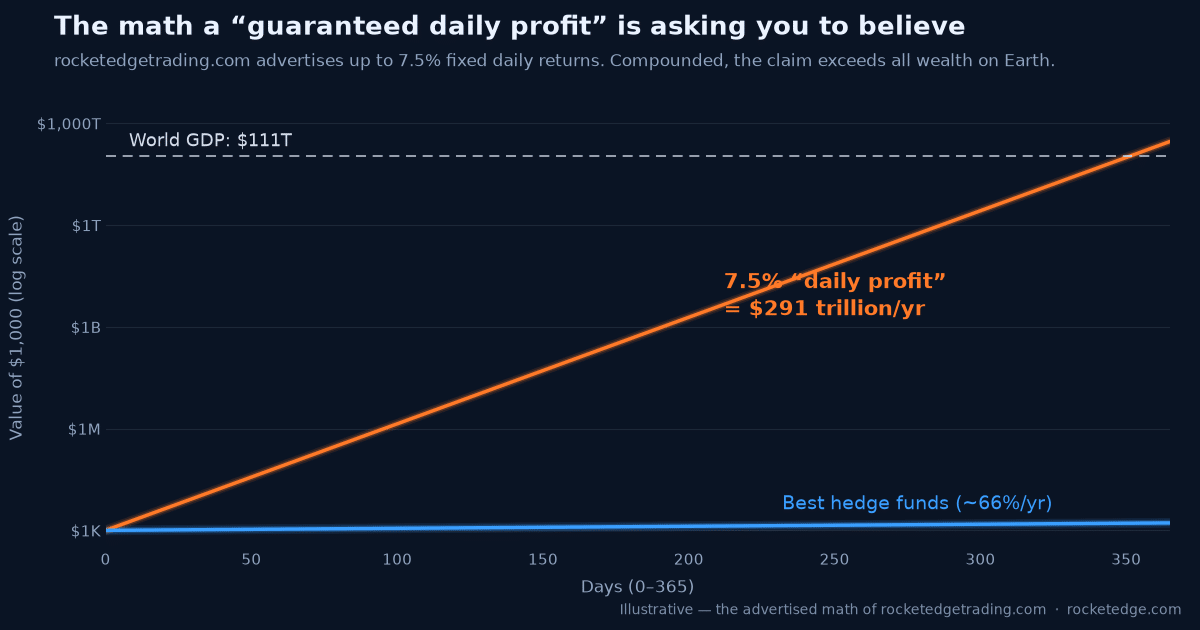
TL;DR: The website rocketedgetrading.com (“RocketEdge Trading”) has no affiliation whatsoever with RocketEdge.com Pte. Ltd., the Singapore AI trading-infrastructure firm behind multiedge.ai. The site promises fixed “daily profits” of 1.5%–7.5% — a mathematical impossibility that compounds a $1,000 deposit into $291 trillion in one year, roughly 2.6x world GDP. We have served a formal cease-and-desist for infringement of our registered ROCKETEDGE® trademark, initiated the legal process to take the domain down, and notified the Monetary Authority of Singapore (MAS) of what we consider obviously fraudulent advertising.
Is RocketEdge Trading (rocketedgetrading.com) affiliated with RocketEdge.com?
No. RocketEdge.com Pte. Ltd. builds AI-powered trading infrastructure for institutional and professional traders — signal platforms, agentic research automation, and strategy-discovery systems on Azure. We do not accept retail deposits, we do not run “investment plans,” and we never promise returns of any kind, let alone fixed daily ones.
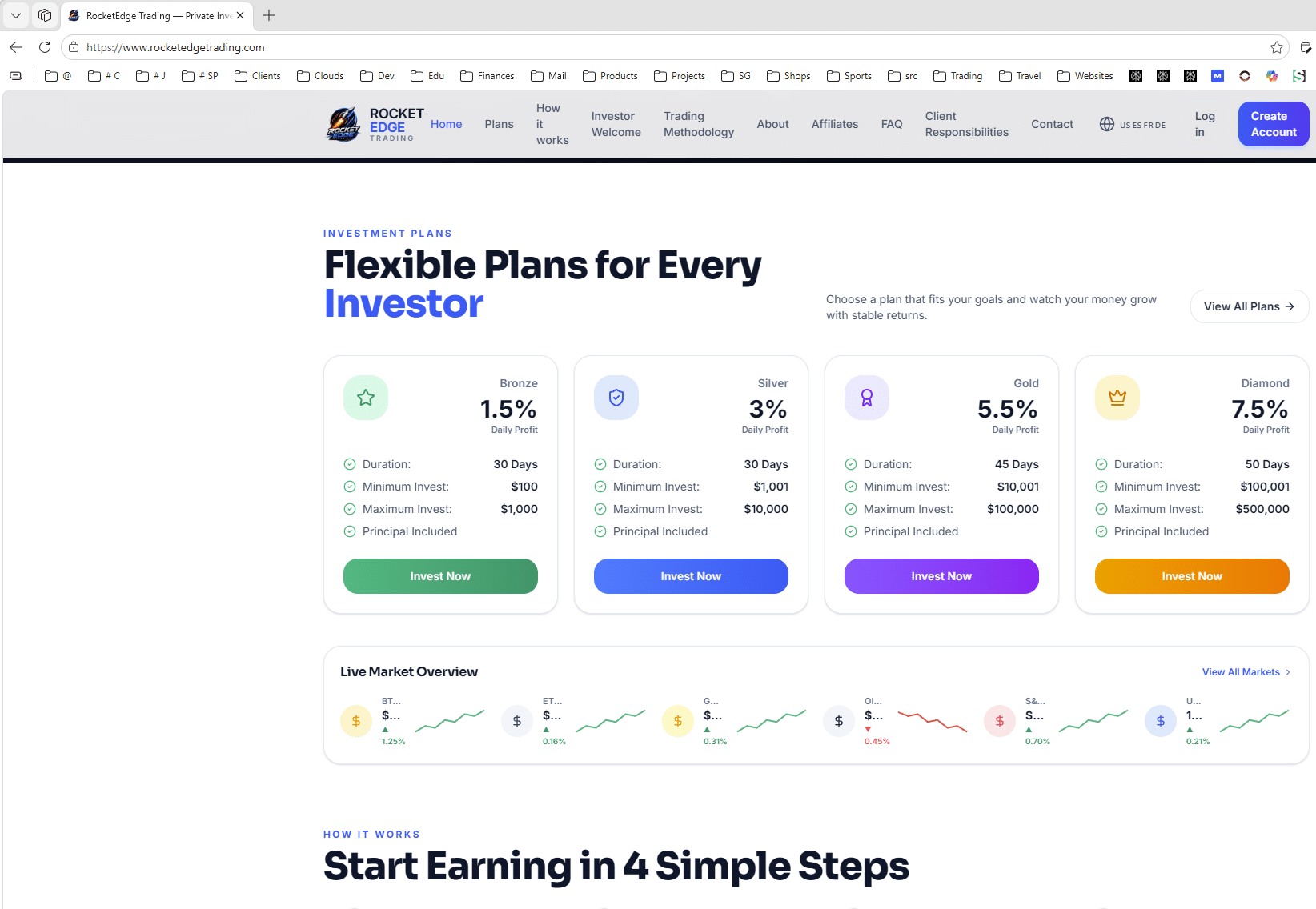
rocketedgetrading.com is an unrelated website, registered on 8 July 2026 — years after our trademark rights vested — that trades on our name. It offers “investment plans” in crypto, forex, and ETFs with “guaranteed” daily profits, tiered like a loyalty program: Bronze at 1.5% daily up to Diamond at 7.5% daily. It names no legal entity, no license number, and no regulator, while claiming to be “Licensed & Registered.”
| RocketEdge.com Pte. Ltd. (us) | rocketedgetrading.com | |
|---|---|---|
| Business | AI trading infrastructure, B2B (multiedge.ai) | Retail “investment plans” in crypto/forex/ETFs |
| Trademark | ROCKETEDGE® — US Reg. No. 5,440,489, WIPO IR 1344149 (EU), UK00801344149, Singapore (IPOS); Classes 9, 35, 36, 38, 41, 42 | None |
| Domain age | Registered and operating for years | Registered 8 July 2026 |
| Return promises | None — we sell software, not returns | Fixed 1.5%–7.5% “daily profit” |
| Legal entity & regulator | Singapore-incorporated, identified | None disclosed |
If you have deposited money there, treat it as a suspected scam: stop further transfers, document everything, and report it to the police and to MAS.
Why do “guaranteed daily profits” prove the advertising is fraudulent?
Apply first-principles reasoning — strip the marketing away and run the arithmetic. A fixed daily return means compounding: each day’s balance is yesterday’s balance times (1 + rate). The premises are the site’s own numbers; the conclusion follows mechanically:
# The arithmetic kill-shot: what "guaranteed daily profit" compounds to
plans = {"Bronze": 0.015, "Silver": 0.03, "Gold": 0.055, "Diamond": 0.075}

for name, r in plans.items():
    annual = (1 + r) ** 365
    print(f"{name}: {r:.1%}/day -> {annual:,.0f}x per year")

# Bronze:  1.5%/day ->             229x per year  (22,800% p.a.)
# Silver:  3.0%/day ->          48,483x per year
# Gold:    5.5%/day ->     307,006,638x per year
# Diamond: 7.5%/day -> 291,131,670,161x per year
At the Diamond tier, a $1,000 deposit becomes $291 trillion in one year — about 2.6x the entire world’s GDP of $111 trillion. For calibration: Renaissance’s Medallion fund, the best-documented track record in quant history, averaged roughly 66% gross per year. The best hedge funds on Earth fight for basis points of edge; nobody prints 7.5% a day. Premise: the returns are advertised as fixed. Premise: fixed daily compounding at these rates exceeds all wealth on Earth within months. Conclusion: the advertised product cannot exist — the advertising is false on its face.
The SEC’s investor alert on high-yield investment programs (HYIPs — unregistered online “programs” promising outsized, fixed returns) names exactly these hallmarks: guaranteed daily percentages, tiered deposit plans, referral commissions, and no identifiable entity or regulator.
What does history say about 7.5% a day?
This is not a new trick; it’s the oldest one, re-skinned. In 1920, Charles Ponzi promised 50% in 45 days — about 1.1% a day — and gave his name to the entire fraud category. In 2016–2018, BitConnect promised roughly 1% daily; the SEC’s complaint noted that amounted to ~3,700% annualized, and the platform collapsed with an estimated $2 billion in investor losses. The “Diamond plan” at 7.5% daily out-promises Charles Ponzi by roughly 7x — a useful base rate (the outside view: how often has this structure ever been real? Zero times in 106 years).
The clarifying analogy: a brand-clone scam site is phishing at the brand layer. Classic phishing spoofs an email address to borrow trust; this spoofs a trademark to borrow a decade of goodwill, SEO equity, and professional reputation. Where the analogy breaks down: phishing steals credentials in seconds, while an HYIP clone farms deposits for weeks — which means evidence accumulates, and enforcement has time to work.
What legal action has RocketEdge taken?
We are not writing this post instead of acting. We are writing it while acting. As of 26 August 2026:
- Formal cease-and-desist served on the operators of rocketedgetrading.com, demanding they cease all use of ROCKETEDGE, deactivate the site, and transfer the domain — with a compliance deadline of 2 September 2026, 17:00 SGT.
- Legal process to take the domain down initiated, including preparation of a UDRP complaint (Uniform Domain-Name Dispute-Resolution Policy — the arbitration procedure under which the WIPO Arbitration and Mediation Center orders infringing domains transferred to the trademark owner; trademark owners filed 6,168 such cases in 2024 alone) and abuse complaints to the domain’s registrar and host.
- MAS notified. Given the fixed-return “investment plans” solicited without any disclosed entity or license, we have reported the site to the Monetary Authority of Singapore, which maintains the public Investor Alert List of unregulated persons wrongly perceived as MAS-licensed. Referrals to the UK FCA, US SEC, and FBI IC3 follow in every jurisdiction where the site solicits investors.
Our claims rest on registered rights in force across the US, EU, UK, and Singapore in Class 36 (financial services) among others — the exact field the clone operates in. Under double-identity rules, an identical mark used for identical services means confusion is presumed, not argued.
Two named mental models drive the enforcement design. Inversion: ask what guarantees failure — waiting politely for a fraudulent operator to answer a letter. So the letter’s real value is evidentiary: it establishes notice and willfulness (which unlocks enhanced damages, including US cybersquatting statutory damages up to $100,000 per domain), while the takedown work proceeds in parallel. Expected value and asymmetry: a UDRP filing costs on the order of $1,500 and complainants win transfer or cancellation in roughly 90% of decided WIPO cases — a convex, capped-downside bet. Court litigation is the escalation path, not the opening move.
Why is fintech brand impersonation exploding now?
Diagnose the stated versus actual causes:
- Stated reason: “Rocket Edge is a generic, coincidental name.” Fails. The domain wholly incorporates a registered mark, was created on 8 July 2026 — years after registration — and is used for the very Class 36 services the registrations cover. That is textbook bad faith under the UDRP.
- Actual reason 1 — trust arbitrage: a clone harvests the trust signal a real brand emits (search results, professional references, domain associations) at near-zero cost. Holds. This is the same economics the FCA warned about when it reported over £78 million stolen through “clone firm” scams.
- Actual reason 2 — the cost of cloning collapsed: AI site builders and template kits produce a polished, plausible fintech front-end in an afternoon for under $50, complete with fake live-market widgets and testimonials. Holds. This is a secular driver, not a cyclical one — the cost curve only goes down.
- Actual reason 3 — enforcement friction: scammers bet that a Singapore SME won’t pursue a four-jurisdiction enforcement action. Partially holds — it’s true of firms that treat trademarks as wall decorations. It fails against firms that treat them as infrastructure.
The bigger context: Singapore alone lost a record $1.1 billion to scams in 2024 across 51,501 reported cases, and WIPO domain-dispute filings sit at record levels. Incentives drive behaviour: a $10 domain against a five-figure expected haul, with cross-border enforcement lag as the moat. Until the expected value flips negative — fast takedowns, registrar liability, regulator blocklisting — supply keeps coming.
How should a fintech respond to trademark infringement? (The edge perspective)
Here is the reframing nobody in the trademark bar will tell you: a trademark registration is not a legal document — it’s incident-response infrastructure. Most founders file a mark, frame the certificate, and never build the operational layer around it. That’s like buying a firewall and never turning on logging. We treat brand protection the way we treat cloud security: an attack surface to be monitored, with a runbook, detection latency targets, and parallel containment tracks. Call it Brand Surface Management.
The runbook that we executed, and that any fintech can copy:
- Detect — monitor domain registrations containing your mark (RDAP is free and machine-readable):
import requests

def domain_age_check(domain: str) -> str:
    r = requests.get(f"https://rdap.org/domain/{domain}", timeout=10)
    events = {e["eventAction"]: e["eventDate"] for e in r.json()["events"]}
    return events.get("registration", "unknown")

print(domain_age_check("rocketedgetrading.com")) # -> 2026-07-08- Preserve evidence first — timestamped captures of the site, WHOIS/RDAP records, and archived snapshots, before the operator can change anything.
- Serve notice — the cease-and-desist, valued as evidence of willfulness, not as the mechanism of victory.
- Contain in parallel — UDRP filing, registrar and host abuse complaints, Google Safe Browsing delisting, and regulator referrals simultaneously. Never sequentially.
- Publish — this post. Defensive SEO ensures that anyone searching the clone’s name finds the truth before they find the deposit page.
What this means for your firm
- Verify before you invest: check any “trading platform” against the MAS Financial Institutions Directory and the Investor Alert List; a real firm names its entity, license, and regulator.
- Run the compounding test: any fixed daily return, compounded for a year, exposes the lie in one line of Python.
- If you run a fintech brand: register your mark in the classes you actually trade in (36 above all), set up domain-registration monitoring on your mark today, and pre-draft your C&D template before you need it.
- If you’ve been affected by rocketedgetrading.com: report to your local police and to MAS, and contact us at rocketedge.com — your report strengthens the enforcement record.
We built RocketEdge on verifiable engineering — the same discipline behind our AI trading infrastructure, our view that cybersecurity and trading infrastructure are converging disciplines, and our warnings about strategies that look too good to be true in backtests. Real quant returns are hard, noisy, and never guaranteed. Anyone telling you otherwise is selling your own money back to you.
FAQ
Is rocketedgetrading.com legitimate?
No. It is not affiliated with RocketEdge.com Pte. Ltd., discloses no legal entity, license, or regulator, and advertises fixed daily returns of 1.5%–7.5% — the defining hallmark of high-yield investment program (HYIP) fraud per the SEC.
Is RocketEdge Trading regulated by MAS?
There is no evidence of any MAS license, and the site names no regulator or entity. We have reported it to MAS; investors should check the MAS Investor Alert List and Financial Institutions Directory before transferring funds to anyone.
What should I do if I already deposited money with rocketedgetrading.com?
Stop all further transfers immediately — including “withdrawal fees,” a classic second-stage extraction. Preserve every record (transactions, chats, emails), report to your bank and the police, and file a report with MAS or your local financial regulator.
How is the real RocketEdge different from RocketEdge Trading?
RocketEdge.com Pte. Ltd. is a Singapore B2B software company: we sell AI trading infrastructure — signal platforms, agentic research, and strategy-discovery tools on multiedge.ai — to institutions. We never take retail deposits and never promise returns.
What is a HYIP scam?
A high-yield investment program (HYIP) is an unregistered online “investment” promising fixed, outsized returns — for example, 1.5% daily — typically paying early investors with later investors’ deposits until it collapses. BitConnect, which promised ~1% daily and collapsed with ~$2 billion in losses, is the canonical modern example.
About RocketEdge: RocketEdge builds AI-powered trading infrastructure for institutional and professional traders in APAC and globally. Our products — MultiEdge AI Signal Fabric, Agentic Research Platform, and AI Trade Idea Generator — are available on Azure Marketplace. → Book a 30-minute Strategy Call